what type.of glue can stick to wire for.pompom
When is a hot mucilage stick non a hot glue stick? When it's PLA, of grade! A glue gun that dispenses molten PLA instead of hot mucilage turned out to be a handy tool for joining 3D-printed objects together, once I had figured out how to print my ain "glue" sticks out of PLA. The upshot is a chip like a plus-sized 3D-press pen, just much simpler and capable of much heavier extrusion. Simply it wasn't quite as simple as shoving scrap PLA into a hot glue gun and mashing the trigger; a few glitches needed to exist ironed out.
Why Utilize a Glue Gun for PLA?
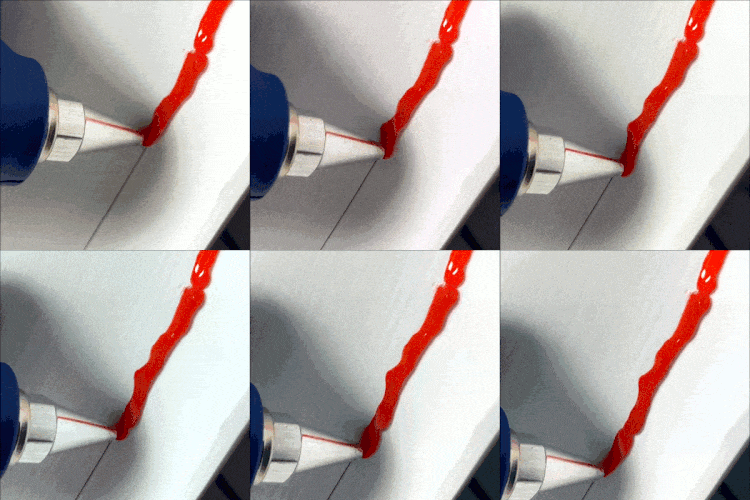 Some solutions come from no more than looking at two dissimilar things while in the right mindset, and realizing they can be mashed together. In this case I had recently segmented a big, hollow, 3D model into smaller 3D-printer-sized pieces and printed them all out, but constitute myself with a problem. I now had a large number of curved, thin-walled pieces that needed to exist connected flush with one another. These were substantially butt joints on all sides — the weakest kind of articulation — offer very fiddling surface for gluing. On meridian of information technology all, the curved surfaces meant clamping was impractical, and any movement of the pieces while gluing would result in other pieces not lining up.
An advantage was that only the exterior of my hollow model was a presentation surface; the inside could be ugly. A hot glue gun is worth considering for a job like this. The idea would be to agree two pieces with the presentation sides lined upwards properly with each other, then anchor the seams together past applying melted gum on the inside (non-presentation) side of the articulation. Let the hot mucilage cool and harden, and repeat. Information technology's a workable process, merely I felt that hot gum just wasn't the correct matter to utilise in this instance. Hot gum can be slow to cool completely, and will always have a bit of flexibility to it. I wanted to piece of work fast, and I wanted the joints to exist difficult and potent. What I actually wanted was melted PLA instead of glue, but I had no way to do information technology. Friction welding the 3D-printed pieces was a possibility only I doubted how maneuverable my rotary tool would be in awkward orientations. I was considering ordering a 3D-printing pen to use as a modest PLA spot welder when I laid eyes on my cheap desktop glue gun.
A mucilage gun had everything I needed: proficient ergonomics, good tip visibility and tactical tactile feedback, and simple mechanical operation. If it could be made to extrude melted PLA instead of hot glue, it would exist the platonic tool for the job. After some initial tests and a discussion with colleagues, it was clear that trying to brand this happen was worth possibly wrecking a cheap glue gun.
Will a Glue Gun Melt PLA?
According to the RepRap Wiki entry for PLA, it softens around sixty °C to 65 °C and melts around 180 °C to 220 °C. Will a gum gun practice the job? To find the reply to this question, I manually pushed a bundle of chip PLA filament through a small desktop mucilage gun that I didn't mind ruining. The mucilage gun was a hobby unit made for lower-temperature glue sticks. The pocket-size hobby unit somewhen melted the PLA only only barely; the PLA came out more like softened putty. Based on this teardown of a cheap hobby glue gun the operating temperature is expected to be around 150 °C, which isn't enough to really melt PLA properly.
Another thing that became clear during this process was that the mucilage gun had special needs for extrusion and feeding. To feed properly, the trigger mechanism needed to be able to grip and button on a solid cylinder, not a bundle of filaments. In addition, proper extrusion required a solid shape that filled the opening of the melting bedchamber completely to prevent backflow. Otherwise, molten plastic prefers to spill out the dorsum instead of being forced through the nozzle. In other words, I needed:
- A college-temperature mucilage gun, and
- A "glue stick" of the correct size and shape made from PLA instead of hot glue
Later on a bit of research, I purchased an economical high-temperature glue gun that claimed 80 Due west and an operating temperature of up to 208 °C.
Testing PLA "Glue Sticks"
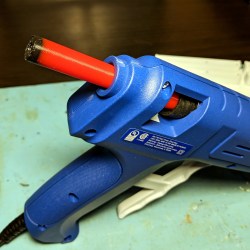
To feed my new glue gun I needed a cylinder eleven mm in diameter and at least 5 in long. Happily, 3D printers exist for the sole purpose of turning 1.75 mm filament into other shapes and sizes. Information technology felt a picayune strange to employ a 3D printer simply to plough 1.75 mm diameter plastic into xi mm diameter plastic, but in well-nigh an 60 minutes I had printed a high (75%) infill 11 mm ten 150 mm cylinder of PLA for testing.
That first stick of PLA was enough to evidence that the 80 Westward glue gun was able to melt and extrude PLA acceptably; the but hitch was a 10 to fifteen minute warmup in my cool workshop, compared to only five minutes or less for hot glue.
However, a trouble was revealed. The feed mechanism for the gum gun has a small levered arm that bites into a glue stick and pushes it forward when the trigger is pulled. However, the PLA "glue stick" was polish and hard, and the feed system could not properly bite into it. In fact, the ridged surface of the PLA cylinder quickly wore abroad the teeth in the little arm as it tried in vain to find something to grab onto.
Feeding Problem Solved by Adding Notches to the PLA Sticks
The solution was a small-scale change to the 3D model for the glue stick. Adding a series of angled notches to the cylinder model immune the raised arm to latch and push perfectly.
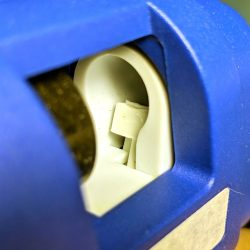
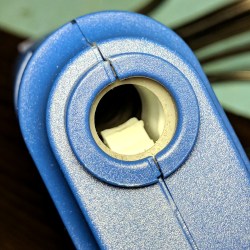
 " data-medium-file="https://hackaday.com/wp-content/uploads/2018/01/pla-glue-stick-in-use.jpg?w=400" data-large-file="https://hackaday.com/wp-content/uploads/2018/01/pla-glue-stick-in-use.jpg?w=625">
Testing The Bonds
With an 80 West mucilage gun doing the melting, and the notches in the cylinder of PLA allowing the feed system do its chore when the trigger was pulled, molten PLA flowed easily and with first-class command. I performed some unproblematic tests:
- Using PLA similar mucilage past depositing a molten blob, then mashing a part down on top of it. Results were expert, just the PLA blob adds some bulk because it doesn't smear out fully before information technology starts to absurd and harden.
- Joining seams: the molten PLA melts only slightly to the surface being joined, but still ends upward surprisingly strong. I was able to pull the seam apart only in the process e'er broke one or the other of the surfaces, or broke the seam itself in two (leaving the remains stuck to the parts I had joined).
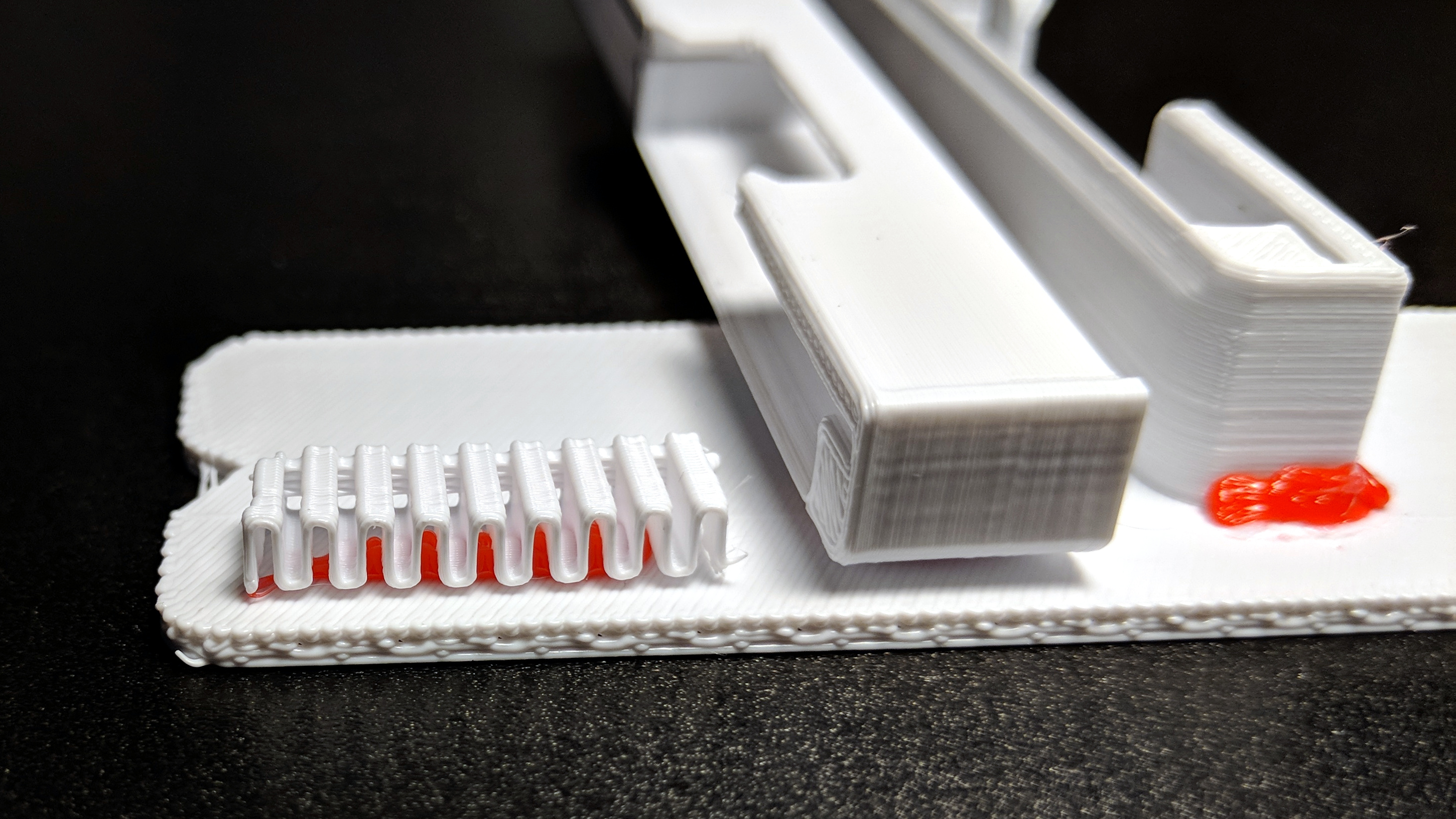
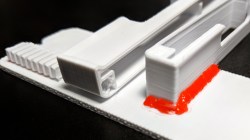
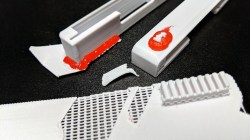


Is There Actually Any Welding Happening?
A true weld results when the fabric of the joint and both pieces meld together to go one. That clearly isn't the example. There is some melting together happening, but it's superficial at all-time. All the same, the consequence easily passes a "tug exam". The cut-away test joint shows the ruby PLA has flowed into and filled every nook and cranny, which probably accounts for well-nigh of the strength.
Lessons Learned
- A small-scale hobby glue gun reliably softened just did non melt PLA. A glue gun made for higher-temperature hot glue melted PLA passably.
- The test glue gun was an economical dual-heater lxxx W unit of measurement that did the job, but takes a good ten minutes or more to warm up and melt the plastic filling the chamber (compared to five minutes or less for hot glue.)
- Aside from rut, the biggest issue keeping PLA from being used in a gum gun is that glue gun feed mechanisms are not made to grip and button on smooth, hard PLA. They expect a much softer hot glue stick. The exam gun functioned well with PLA sticks that had notches in the side, simply this will vary depending on the pattern of the specific glue gun beingness used.
- The STL file for my simple notched glue stick is bachelor on GitHub. It may or may not be compatible with other glue gun feed systems.
- It'south not much of a weld since it's superficial only, but it still takes more than casual attempt to pull pieces apart.
- Experimenting is fun.
Does The PLA Glue Gun Practise the Chore?
My large multi-piece 3D print was a big hollow object with thin pieces plumbing fixtures together like a jigsaw puzzle, and using the PLA gum gun to quickly and efficiently stick those 3D-printed pieces together with no demand for clamping was better than expected.
For situations where a PLA glue gun may not do the chore, check out this method to ease printing and assembly of multi-part models with a bit of help from OpenSCAD. Just for my big hollow model, manually aligning the surfaces and bonding the inside seams was quick, piece of cake, sturdy, and absolutely worth repurposing a $30 glue gun and giving it a place in the tool drawer.
Source: https://hackaday.com/2018/02/05/3d-printering-printing-sticks-for-a-pla-hot-glue-gun/
0 Response to "what type.of glue can stick to wire for.pompom"
Publicar un comentario